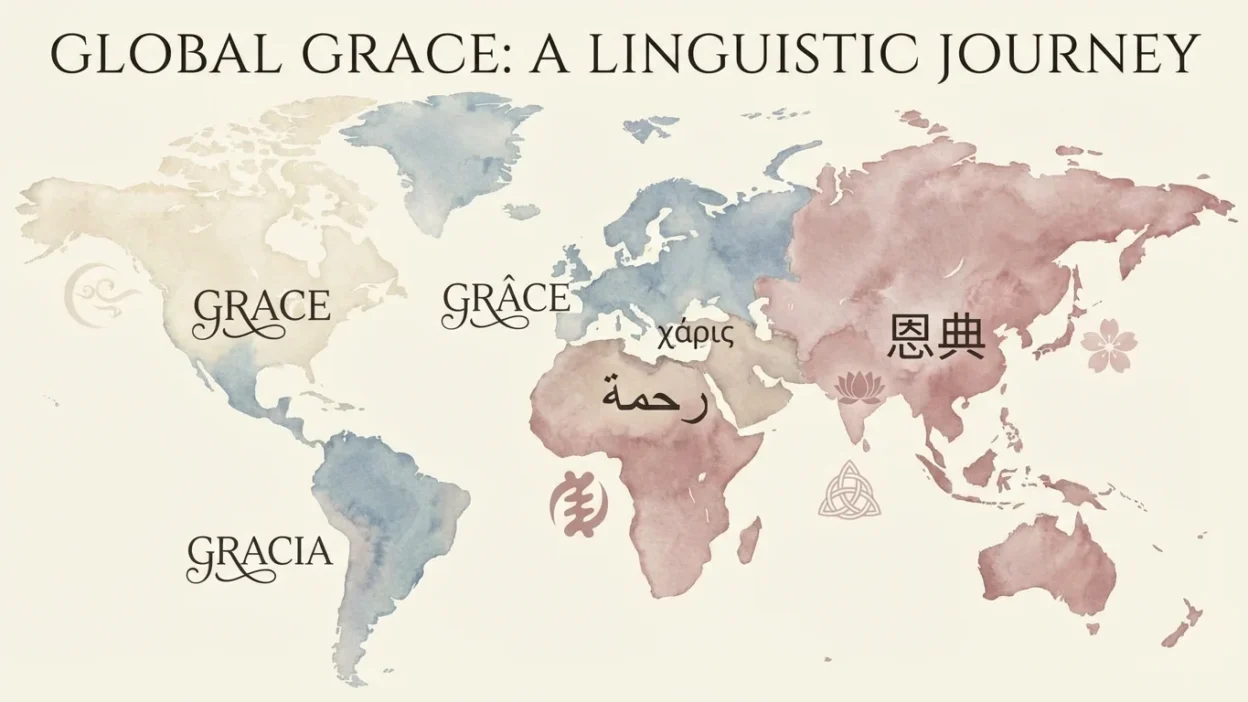
The word grace carries deep meaning across cultures and languages. It can represent elegance, kindness, divine blessing, or a sense of calm beauty. In everyday life, grace may describe someone’s gentle character, refined movement, or spiritual favor. Learning grace in different languages helps you understand how this meaningful concept is expressed around the world.
In this guide, you will discover how to say grace in different languages, including pronunciation and example sentences. These grace translations around the world will expand your vocabulary and help you appreciate how different cultures express beauty and kindness through language.
Grace in Different Languages
| Language | Phrase | Example Sentence |
|---|---|---|
| English | Grace (grays) | She speaks with grace and kindness. (She speaks politely) |
| Spanish | Gracia (gra-see-ah) | Ella tiene mucha gracia. (She has a lot of grace) |
| French | Grâce (grass) | Elle agit avec grâce. (She acts with grace) |
| German | Gnade (gna-de) | Sie bewegt sich mit Gnade. (She moves with grace) |
| Italian | Grazia (gra-tsia) | Lei ha molta grazia. (She has much grace) |
| Portuguese | Graça (gra-sa) | Ela fala com graça. (She speaks with grace) |
| Dutch | Genade (ghe-na-de) | Zij toont genade. (She shows grace) |
| Russian | Грация (gra-tsi-ya) | Она движется с грацией. (She moves with grace) |
| Chinese (Mandarin) | 优雅 (you-ya) | 她很优雅. (She is graceful) |
| Japanese | 優雅 (yu-ga) | 彼女は優雅です. (She is graceful) |
| Korean | 우아함 (woo-a-ham) | 그녀는 우아합니다. (She is graceful) |
| Arabic | نعمة (ni-ma) | تتحرك بنعمة. (She moves with grace) |
| Hindi | अनुग्रह (a-nu-grah) | वह अनुग्रह से बोलती है। (She speaks with grace) |
| Urdu | عنایت (ina-yat) | وہ عنایت سے بولتی ہے۔ (She speaks with grace) |
| Turkish | Zarafet (za-ra-fet) | O zarafetle yürür. (She walks with grace) |
| Greek | Χάρη (ha-ri) | Έχει μεγάλη χάρη. (She has great grace) |
| Polish | Łaska (wa-ska) | Ona mówi z łaską. (She speaks with grace) |
| Swedish | Nåd (nod) | Hon rör sig med nåd. (She moves with grace) |
| Danish | Nåde (no-de) | Hun taler med nåde. (She speaks with grace) |
| Norwegian | Nåde (no-de) | Hun beveger seg med nåde. (She moves with grace) |
| Finnish | Armo (ar-mo) | Hän puhuu armolla. (She speaks with grace) |
| Czech | Milost (mi-lost) | Mluví s milostí. (She speaks with grace) |
| Slovak | Milosť (mi-losh) | Hovorí s milosťou. (She speaks with grace) |
| Hungarian | Kegyelem (ke-gyel-em) | Kegyelemmel beszél. (She speaks with grace) |
| Romanian | Grație (gra-tsie) | Ea vorbește cu grație. (She speaks with grace) |
| Bulgarian | Благодат (bla-go-dat) | Тя говори с благодат. (She speaks with grace) |
| Serbian | Милост (mi-lost) | Она говори са милошћу. (She speaks with grace) |
| Croatian | Milost (mi-lost) | Ona govori s milošću. (She speaks with grace) |
| Slovenian | Milost (mi-lost) | Govori z milostjo. (She speaks with grace) |
| Ukrainian | Благодать (bla-ho-dat) | Вона говорить з благодаттю. (She speaks with grace) |
| Hebrew | חן (khen) | היא מדברת בחן. (She speaks with grace) |
| Persian | فیض (feyz) | او با فیض صحبت میکند. (She speaks with grace) |
| Thai | ความสง่างาม (kwam sa-ngam) | เธอพูดอย่างสง่างาม. (She speaks gracefully) |
| Vietnamese | Ân sủng (an sung) | Cô ấy nói với ân sủng. (She speaks with grace) |
| Indonesian | Anugerah (a-nu-ge-rah) | Dia berbicara dengan anugerah. (She speaks with grace) |
| Malay | Anugerah (a-nu-ge-rah) | Dia bercakap dengan anugerah. (She speaks with grace) |
| Filipino | Biyaya (bi-ya-ya) | Nagsasalita siya nang may biyaya. (She speaks with grace) |
| Swahili | Neema (ne-ma) | Anaongea kwa neema. (She speaks with grace) |
| Zulu | Umusa (u-mu-sa) | Ukhuluma ngomusa. (She speaks with grace) |
| Afrikaans | Genade (ghe-na-de) | Sy praat met genade. (She speaks with grace) |
| Icelandic | Náð (nouth) | Hún talar með náð. (She speaks with grace) |
| Irish | Grásta (gra-sta) | Labhraíonn sí le grásta. (She speaks with grace) |
| Welsh | Gras (gras) | Mae hi’n siarad gyda gras. (She speaks with grace) |
| Estonian | Arm (arm) | Ta räägib armuga. (She speaks with grace) |
| Latvian | Žēlastība (zhe-las-ti-ba) | Viņa runā ar žēlastību. (She speaks with grace) |
| Lithuanian | Malonė (ma-lo-ne) | Ji kalba su malone. (She speaks with grace) |
| Albanian | Hir (heer) | Ajo flet me hir. (She speaks with grace) |
| Macedonian | Милост (mi-lost) | Таа зборува со милост. (She speaks with grace) |
| Georgian | მადლი (mad-li) | ის მადლით საუბრობს. (She speaks with grace) |
| Armenian | շնորհ (shnorh) | Նա խոսում է շնորհով։ (She speaks with grace) |
| Mongolian | Нигүүлсэл (ni-guul-sel) | Тэр нигүүлсэлтэй ярьдаг. (She speaks with grace) |
| Nepali | कृपा (kri-pa) | उनी कृपाले बोल्छिन्। (She speaks with grace) |
| Sinhala | කරුණාව (ka-ru-na-wa) | ඇය කරුණාවෙන් කතා කරයි. (She speaks with grace) |
| Bengali | অনুগ্রহ (o-nu-gro-ho) | সে অনুগ্রহ দিয়ে কথা বলে। (She speaks with grace) |
| Tamil | அருள் (a-rul) | அவள் அருளுடன் பேசுகிறாள். (She speaks with grace) |
| Telugu | కృప (kru-pa) | ఆమె కృపతో మాట్లాడుతుంది. (She speaks with grace) |
| Kannada | ಕೃಪೆ (kru-pe) | ಅವಳು ಕೃಪೆಯಿಂದ ಮಾತನಾಡುತ್ತಾಳೆ. (She speaks with grace) |
| Marathi | कृपा (kru-pa) | ती कृपेसह बोलते. (She speaks with grace) |
| Gujarati | કૃપા (kru-pa) | તે કૃપાથી બોલે છે. (She speaks with grace) |
| Punjabi | ਕਿਰਪਾ (kir-pa) | ਉਹ ਕਿਰਪਾ ਨਾਲ ਬੋਲਦੀ ਹੈ। (She speaks with grace) |
| Khmer | ព្រះគុណ (preah-kun) | នាងនិយាយដោយព្រះគុណ. (She speaks with grace) |
| Lao | ພຣະຄຸນ (phra-khun) | ນາງເວົ້າດ້ວຍພຣະຄຸນ. (She speaks with grace) |
| Burmese | ကျေးဇူး (kye-zu) | သူမ ကျေးဇူးဖြင့် ပြောသည်. (She speaks with grace) |
| Amharic | ጸጋ (tse-ga) | በጸጋ ትናገራለች. (She speaks with grace) |
| Somali | Naxariis (na-kha-rees) | Waxay ku hadashaa naxariis. (She speaks with grace) |
| Hausa | Alheri (al-he-ri) | Tana magana da alheri. (She speaks with grace) |
| Yoruba | Ore-ọfẹ (o-re o-fe) | O soro pelu ore-ọfẹ. (She speaks with grace) |
| Igbo | Amara (a-ma-ra) | O na-ekwu na amara. (She speaks with grace) |
The Meaning of Grace Across Cultures
The word grace can have multiple meanings depending on context. In many languages, it refers to elegance, kindness, mercy, or divine blessing. Some cultures associate grace with spiritual favor, while others link it to beauty and polite behavior.
Learning grace translations around the world helps you understand these cultural perspectives and how different societies interpret this meaningful word.
How the Word Grace Is Used in Everyday Life
Grace appears in many everyday situations. It may describe someone’s behavior, personality, or movements.
Common examples include:
- Describing elegance in movement or speech
- Talking about kindness and forgiveness
- Expressing spiritual blessing or favor
Understanding how to say grace in different languages helps people communicate positive qualities like kindness and elegance.
Benefits of Learning Grace in Different Languages
Learning meaningful words like grace expands your vocabulary and cultural awareness. It helps language learners understand emotional and spiritual expressions in different cultures.
Knowing grace in all languages can also improve cross-cultural communication and deepen appreciation for global languages.
Conclusion
Grace is a powerful word that represents kindness, elegance, and compassion across cultures. While languages express it differently, the meaning often reflects positive human qualities.
By learning these translations, you can better understand how grace is expressed around the world.
FAQs
1. What does grace mean in different languages?
In most languages, grace refers to elegance, kindness, mercy, or divine blessing.
2. How do you say grace in many languages?
Examples include Gracia (Spanish), Grâce (French), Gnade (German), and 优雅 (Chinese).
3. Why is grace an important word across cultures?
It represents positive qualities such as kindness, beauty, and compassion.
4. Is grace used in both religious and everyday language?
Yes, it can describe spiritual blessings as well as elegance or polite behavior.
5. Can learning words like grace help with language learning?
Yes, understanding meaningful words improves cultural awareness and vocabulary.