
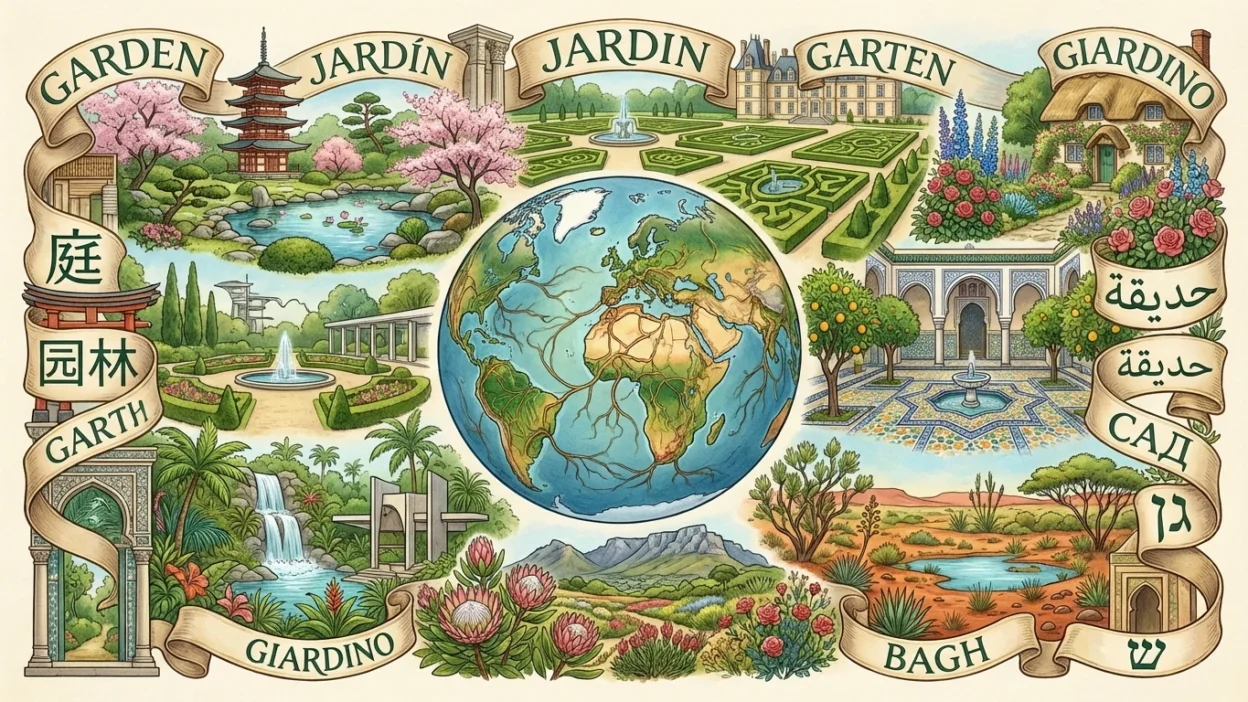
A garden is a peaceful and beautiful place where people grow flowers, fruits, vegetables, and plants. Gardens exist in almost every culture, whether they are small backyard spaces, public parks, or traditional botanical gardens. Because gardens are such an important part of nature and daily life, the word garden appears in many languages around the world.
Learning garden in different languages helps travelers, language learners, and nature lovers understand how different cultures talk about green spaces.
In this guide, you will discover 70 garden translations around the world, along with pronunciation and simple example sentences that show how the word is used in everyday conversation.
Garden in 70 Different Languages Around the World
| Language | Phrase & Pronunciation | Example Sentence |
|---|---|---|
| English | Garden (GAR-den) | The flowers are blooming in the garden. |
| Spanish | Jardín (har-DEEN) | Las flores crecen en el jardín. |
| French | Jardin (zhar-DAN) | Les fleurs poussent dans le jardin. |
| German | Garten (GAR-ten) | Die Blumen wachsen im Garten. |
| Italian | Giardino (jar-DEE-no) | I fiori crescono nel giardino. |
| Portuguese | Jardim (zhar-JEEN) | As flores crescem no jardim. |
| Dutch | Tuin (town) | De bloemen groeien in de tuin. |
| Russian | Сад (sad) | Цветы растут в саду. |
| Ukrainian | Сад (sad) | Квіти ростуть у саду. |
| Polish | Ogród (O-groot) | Kwiaty rosną w ogrodzie. |
| Czech | Zahrada (za-HRA-da) | Květiny rostou v zahradě. |
| Slovak | Záhrada (ZA-hra-da) | Kvety rastú v záhrade. |
| Hungarian | Kert (kert) | A virágok a kertben nőnek. |
| Romanian | Grădină (gra-DEE-na) | Florile cresc în grădină. |
| Greek | Κήπος (KEE-pos) | Τα λουλούδια μεγαλώνουν στον κήπο. |
| Turkish | Bahçe (BAH-che) | Çiçekler bahçede büyür. |
| Arabic | حديقة (ha-DEE-qa) | الزهور تنمو في الحديقة. |
| Hebrew | גן (gan) | הפרחים גדלים בגן. |
| Persian | باغ (bagh) | گلها در باغ رشد میکنند. |
| Hindi | बगीचा (ba-GEE-cha) | बगीचे में फूल खिलते हैं। |
| Urdu | باغ (baagh) | باغ میں پھول کھلتے ہیں۔ |
| Bengali | বাগান (ba-gan) | বাগানে ফুল ফোটে। |
| Punjabi | ਬਾਗ (baag) | ਬਾਗ ਵਿੱਚ ਫੁੱਲ ਖਿੜਦੇ ਹਨ। |
| Gujarati | બગીચો (ba-GEE-cho) | બગીચામાં ફૂલ ખીલે છે. |
| Marathi | बाग (baag) | बागेत फुले उमलतात. |
| Tamil | தோட்டம் (tho-tam) | தோட்டத்தில் மலர்கள் மலர்கின்றன. |
| Telugu | తోట (tho-ta) | తోటలో పూలు వికసిస్తాయి. |
| Kannada | ತೋಟ (tho-ta) | ತೋಟದಲ್ಲಿ ಹೂವುಗಳು ಅರಳುತ್ತವೆ. |
| Malayalam | തോട്ടം (tho-tam) | തോട്ടത്തിൽ പൂക്കൾ വിരിയുന്നു. |
| Sinhala | උයන (u-ya-na) | උයනේ මල් පිපේ. |
| Thai | สวน (suan) | ดอกไม้เติบโตในสวน. |
| Vietnamese | Vườn (voon) | Hoa mọc trong vườn. |
| Indonesian | Taman (ta-man) | Bunga tumbuh di taman. |
| Malay | Taman (ta-man) | Bunga tumbuh di taman. |
| Filipino | Hardin (har-din) | Tumutubo ang mga bulaklak sa hardin. |
| Chinese (Mandarin) | 花园 (hua-yuan) | 花在花园里生长. |
| Japanese | 庭 (ni-wa) | 庭に花が咲いています。 |
| Korean | 정원 (jeong-won) | 정원에 꽃이 핍니다. |
| Mongolian | Цэцэрлэг (tse-tser-leg) | Цэцэрлэгт цэцэг ургадаг. |
| Swahili | Bustani (bus-ta-ni) | Maua hukua bustanini. |
| Zulu | Ingadi (in-ga-di) | Izimbali zikhula engadini. |
| Afrikaans | Tuin (town) | Blomme groei in die tuin. |
| Somali | Beer (beer) | Ubax ayaa ku baxa beerta. |
| Amharic | አትክልት (at-kilt) | አበቦች በአትክልት ይበቅላሉ. |
| Hausa | Lambu (lam-bu) | Furanni suna girma a lambu. |
| Yoruba | Ọgba (og-ba) | Awọn ododo dagba ninu ọgba. |
| Igbo | Ubi (u-bi) | Okooko na-eto na ubi. |
| Danish | Have (ha-ve) | Blomster vokser i haven. |
| Swedish | Trädgård (tred-gord) | Blommor växer i trädgården. |
| Norwegian | Hage (ha-ge) | Blomster vokser i hagen. |
| Finnish | Puutarha (poo-tar-ha) | Kukat kasvavat puutarhassa. |
| Icelandic | Garður (gar-dur) | Blóm vaxa í garðinum. |
| Estonian | Aed (aed) | Lilled kasvavad aias. |
| Latvian | Dārzs (darz) | Ziedi aug dārzā. |
| Lithuanian | Sodas (so-das) | Gėlės auga sode. |
| Serbian | Башта (bash-ta) | Цвеће расте у башти. |
| Croatian | Vrt (vurt) | Cvijeće raste u vrtu. |
| Bosnian | Bašta (bash-ta) | Cvijeće raste u bašti. |
| Slovenian | Vrt (vurt) | Rože rastejo na vrtu. |
| Albanian | Kopsht (kop-sht) | Lulet rriten në kopsht. |
| Macedonian | Градина (gra-di-na) | Цвеќиња растат во градина. |
| Georgian | ბაღი (ba-ghi) | ყვავილები ბაღში იზრდება. |
| Armenian | Այգի (ay-gi) | Ծաղիկները աճում են այգում. |
| Kazakh | Бақша (bak-sha) | Гүлдер бақшада өседі. |
| Uzbek | Bog‘ (bog) | Gullar bog‘da o‘sadi. |
| Tajik | Боғ (bogh) | Гулҳо дар боғ мерӯянд. |
| Nepali | बगैंचा (ba-gain-cha) | बगैंचामा फूल फुल्छन्। |
| Khmer | សួន (suon) | ផ្កាដុះនៅក្នុងសួន. |
| Lao | ສວນ (suan) | ດອກໄມ້ເຕີບໃນສວນ. |
The Importance of Gardens Around the World
Gardens are an important part of many cultures. Some people grow gardens for food, while others create them for beauty and relaxation. From Japanese zen gardens to European flower gardens, these spaces connect people with nature.
When exploring garden in all languages, you will notice that many words are deeply connected to agriculture, nature, and traditional lifestyles.
How the Word Garden Is Used in Daily Conversations
People commonly use the word garden when talking about:
Planting flowers and vegetables
Home landscaping and backyard spaces
Public parks and botanical gardens
Nature and outdoor relaxation
Understanding garden translations around the world can help travelers and language learners describe outdoor spaces in different countries.
Why Learning Nature Words in Different Languages Is Helpful
Nature vocabulary is useful for travel, gardening, and environmental discussions. Learning how to say garden in different languages helps people communicate about plants, parks, and outdoor spaces with people from different cultures.
It also helps language learners expand their vocabulary with practical everyday words.
Conclusion
Gardens symbolize beauty, peace, and growth in many cultures. Although the word changes from language to language, the idea of a garden remains universal.
By learning garden in different languages, you gain a deeper understanding of how people around the world talk about nature and green spaces.
FAQs
What is the word garden in different languages?
Examples include Jardín (Spanish), Jardin (French), Garten (German), Bahçe (Turkish), and 花园 (Chinese).
How do you say garden in 10 common languages?
English (Garden), Spanish (Jardín), French (Jardin), German (Garten), Italian (Giardino), Arabic (Hadiqa), Hindi (Bagicha), Japanese (Niwa), Chinese (Huayuan), and Turkish (Bahçe).
Why are gardens important in many cultures?
Gardens provide food, beauty, relaxation, and a connection with nature.
Is garden vocabulary useful for travelers?
Yes, it helps when discussing parks, outdoor spaces, and sightseeing locations.
Do all languages have a word for garden?
Yes, every language has words related to gardens, farms, or cultivated green spaces.