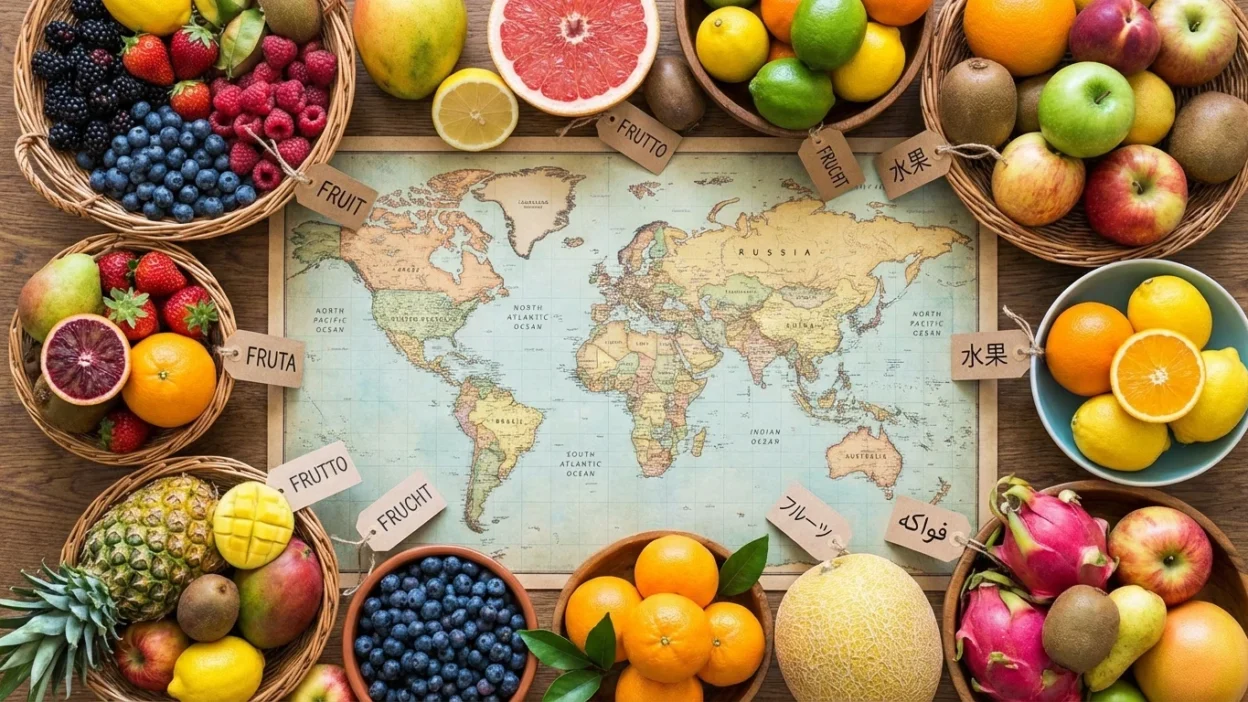
The word fruit is used to describe sweet and edible parts of plants like apples, bananas, and oranges. It is a common everyday word connected to food, health, and nature. While fruits are enjoyed worldwide, the word for “fruit” changes across languages.
Learning fruit in different languages is useful for travelers, language learners, and food lovers. It helps in markets, restaurants, and daily conversations. In this guide, you’ll discover 70 fruit translations around the world, along with pronunciation and simple example sentences.
Fruit in 70 Different Languages Around the World
| Language | Phrase & Pronunciation | Example Sentence |
|---|---|---|
| English | Fruit (froot) | I eat fruit every day. |
| Spanish | Fruta (FROO-ta) | Como fruta todos los días. |
| French | Fruit (frwee) | Je mange des fruits. |
| German | Obst (ohpst) | Ich esse Obst täglich. |
| Italian | Frutta (FROOT-ta) | Mangio frutta ogni giorno. |
| Portuguese | Fruta (FROO-ta) | Eu como fruta todos os dias. |
| Dutch | Fruit (froit) | Ik eet elke dag fruit. |
| Russian | Фрукты (FROOK-ty) | Я ем фрукты каждый день. |
| Ukrainian | Фрукти (FROOK-ty) | Я їм фрукти щодня. |
| Polish | Owoce (o-VO-tse) | Jem owoce codziennie. |
| Czech | Ovoce (o-VO-tse) | Jím ovoce každý den. |
| Slovak | Ovocie (o-VO-tsi-eh) | Jem ovocie každý deň. |
| Hungarian | Gyümölcs (gyu-molch) | Minden nap eszem gyümölcsöt. |
| Romanian | Fructe (FRUK-te) | Mănânc fructe zilnic. |
| Greek | Φρούτα (FROO-ta) | Τρώω φρούτα κάθε μέρα. |
| Turkish | Meyve (mey-ve) | Her gün meyve yerim. |
| Arabic | فاكهة (fa-ki-ha) | آكل الفاكهة كل يوم. |
| Hebrew | פרי (pri) | אני אוכל פרי כל יום. |
| Persian | میوه (mi-ve) | من هر روز میوه میخورم. |
| Hindi | फल (phal) | मैं रोज फल खाता हूँ। |
| Urdu | پھل (phal) | میں روز پھل کھاتا ہوں۔ |
| Bengali | ফল (fol) | আমি প্রতিদিন ফল খাই। |
| Punjabi | ਫਲ (phal) | ਮੈਂ ਹਰ ਰੋਜ਼ ਫਲ ਖਾਂਦਾ ਹਾਂ। |
| Gujarati | ફળ (phal) | હું દરરોજ ફળ ખાઉં છું. |
| Marathi | फळे (pha-le) | मी रोज फळे खातो. |
| Tamil | பழம் (pa-zham) | நான் தினமும் பழம் சாப்பிடுகிறேன். |
| Telugu | పండు (pan-du) | నేను ప్రతిరోజూ పండ్లు తింటాను. |
| Kannada | ಹಣ್ಣು (han-nu) | ನಾನು ಪ್ರತಿದಿನ ಹಣ್ಣು ತಿನ್ನುತ್ತೇನೆ. |
| Malayalam | പഴം (pa-zham) | ഞാൻ ദിവസവും പഴം കഴിക്കുന്നു. |
| Sinhala | පලතුරු (pa-la-tu-ru) | මම දිනපතා පලතුරු කනවා. |
| Thai | ผลไม้ (phon-la-mai) | ฉันกินผลไม้ทุกวัน. |
| Vietnamese | Trái cây (trai cay) | Tôi ăn trái cây mỗi ngày. |
| Indonesian | Buah (bu-ah) | Saya makan buah setiap hari. |
| Malay | Buah (bu-ah) | Saya makan buah setiap hari. |
| Filipino | Prutas (pru-tas) | Kumakain ako ng prutas araw-araw. |
| Chinese (Mandarin) | 水果 (shui guo) | 我每天吃水果. |
| Japanese | 果物 (ku-da-mo-no) | 毎日果物を食べます。 |
| Korean | 과일 (gwa-il) | 나는 매일 과일을 먹는다. |
| Mongolian | Жимс (jim-s) | Би өдөр бүр жимс иддэг. |
| Swahili | Matunda (ma-tun-da) | Ninakula matunda kila siku. |
| Zulu | Izithelo (i-zi-the-lo) | Ngidla izithelo nsuku zonke. |
| Afrikaans | Vrugte (vrug-te) | Ek eet vrugte elke dag. |
| Somali | Miraha (mi-ra-ha) | Waxaan cunaa miraha maalin kasta. |
| Amharic | ፍራፍሬ (fi-ra-fre) | እኔ በየቀኑ ፍራፍሬ እበላለሁ. |
| Hausa | ‘Ya’yan itace (ya-yan i-ta-che) | Ina cin ‘ya’yan itace kullum. |
| Yoruba | Eso (e-so) | Mo jẹ eso lojoojumọ. |
| Igbo | Mkpụrụ osisi (m-kpu-ru o-si-si) | Ana m eri mkpụrụ osisi kwa ụbọchị. |
| Danish | Frugt (frugt) | Jeg spiser frugt hver dag. |
| Swedish | Frukt (frukt) | Jag äter frukt varje dag. |
| Norwegian | Frukt (frukt) | Jeg spiser frukt hver dag. |
| Finnish | Hedelmä (he-del-ma) | Syön hedelmiä joka päivä. |
| Icelandic | Ávextir (au-vek-tir) | Ég borða ávexti daglega. |
| Estonian | Puuvili (puu-vi-li) | Ma söön puuvilju iga päev. |
| Latvian | Augļi (aug-li) | Es ēdu augļus katru dienu. |
| Lithuanian | Vaisiai (vai-si-ai) | Aš valgau vaisius kasdien. |
| Serbian | Воће (vo-che) | Једем воће сваки дан. |
| Croatian | Voće (vo-che) | Jedem voće svaki dan. |
| Bosnian | Voće (vo-che) | Jedem voće svaki dan. |
| Slovenian | Sadje (sad-ye) | Jem sadje vsak dan. |
| Albanian | Fruta (fru-ta) | Unë ha fruta çdo ditë. |
| Macedonian | Овошје (o-vo-shye) | Јадам овошје секој ден. |
| Georgian | ხილი (khi-li) | მე ყოველდღე ხილი ვჭამ. |
| Armenian | Մրգեր (mr-ger) | Ես ամեն օր մրգեր եմ ուտում. |
| Kazakh | Жеміс (zhe-mis) | Мен күнде жеміс жеймін. |
| Uzbek | Meva (me-va) | Men har kuni meva yeyman. |
| Tajik | Мева (me-va) | Ман ҳар рӯз мева мехӯрам. |
| Nepali | फलफूल (phal-phool) | म हरेक दिन फलफूल खान्छु। |
| Khmer | ផ្លែឈើ (phle chheu) | ខ្ញុំញ៉ាំផ្លែឈើរៀងរាល់ថ្ងៃ. |
| Lao | ຫມາກໄມ້ (mak mai) | ຂ້ອຍກິນຫມາກໄມ້ທຸກມື້. |
The Meaning of “Fruit” in Different Languages
The word fruit refers to edible plant products that are usually sweet and rich in vitamins. It is a basic and essential part of daily diet across cultures.
When exploring fruit in all languages, you may notice that some languages use plural forms or collective nouns to describe fruits.
How the Word Fruit Is Used in Everyday Conversations
People use the word fruit when talking about:
Food and nutrition
Shopping in markets
Healthy eating habits
Cooking and recipes
Understanding fruit translations around the world helps in daily life, especially while traveling or dining.
Why Learning Food Vocabulary in Different Languages Is Important
Food is a universal topic. Knowing how to say fruit in different languages helps you communicate easily in markets, restaurants, and kitchens worldwide.
It also enhances cultural understanding and practical language skills.
Conclusion
The word fruit is simple but essential in everyday life. While each language expresses it differently, the meaning remains the same across the globe.
By learning fruit in different languages, you expand your vocabulary and improve communication in real-life situations.
FAQs
What is fruit in different languages?
Examples include Fruta (Spanish), Fruit (French), Obst (German), Meyve (Turkish), and 水果 (Chinese).
How do you say fruit in 10 common languages?
English (Fruit), Spanish (Fruta), French (Fruit), German (Obst), Italian (Frutta), Arabic (Fakiha), Hindi (Phal), Chinese (Shui Guo), Japanese (Kudamono), and Turkish (Meyve).
Do all languages use the same word for fruit?
No, some use collective or plural forms instead of a singular word.
Why is fruit vocabulary important?
It is commonly used in daily conversations related to food and health.
Is fruit a basic word in language learning?
Yes, it is part of essential vocabulary for beginners.