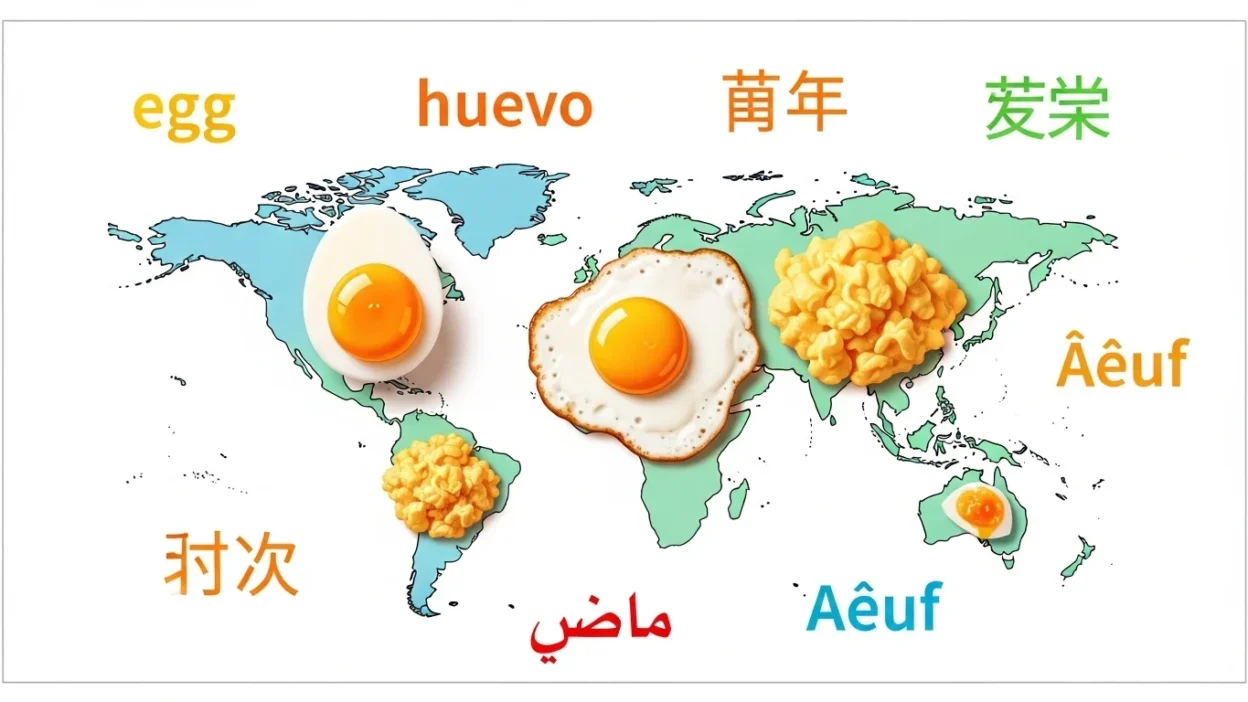
Learning how to say egg in different languages is useful for travel, cooking, and everyday communication. From ordering food to understanding recipes, knowing these egg translations can make your life easier anywhere in the world.
In this guide, you’ll discover how to say egg in different languages, including pronunciation and simple real life examples. This makes learning fast, practical, and easy to remember.
Egg in All Languages 70 Global Translations Table
Below is a clean, mobile-friendly table showing egg around the world, with pronunciation and example sentences.
| Language | Phrase | Example Sentence |
|---|---|---|
| English | Egg (eg) | I ate an egg. (I ate an egg.) |
| Spanish | Huevo (weh-vo) | Comí un huevo. (I ate an egg.) |
| French | Œuf (uhf) | Je mange un œuf. (I eat an egg.) |
| German | Ei (eye) | Ich esse ein Ei. (I eat an egg.) |
| Italian | Uovo (wo-vo) | Mangio un uovo. (I eat an egg.) |
| Portuguese | Ovo (o-vo) | Eu como um ovo. (I eat an egg.) |
| Dutch | Ei (eye) | Ik eet een ei. (I eat an egg.) |
| Russian | Яйцо (yai-tso) | Я ем яйцо. (I eat an egg.) |
| Chinese (Mandarin) | 鸡蛋 (jī dàn) | 我吃鸡蛋。 (I eat eggs.) |
| Japanese | 卵 (tamago) | 卵を食べます。 (I eat eggs.) |
| Korean | 계란 (gye-ran) | 계란을 먹어요. (I eat eggs.) |
| Arabic | بيضة (bay-da) | آكل بيضة. (I eat an egg.) |
| Hindi | अंडा (an-da) | मैं अंडा खाता हूँ। (I eat an egg.) |
| Urdu | انڈا (anda) | میں انڈا کھاتا ہوں۔ (I eat an egg.) |
| Turkish | Yumurta (yu-mur-ta) | Yumurta yiyorum. (I eat an egg.) |
| Greek | Αυγό (av-go) | Τρώω ένα αυγό. (I eat an egg.) |
| Polish | Jajko (yai-ko) | Jem jajko. (I eat an egg.) |
| Swedish | Ägg (egg) | Jag äter ett ägg. (I eat an egg.) |
| Norwegian | Egg (egg) | Jeg spiser et egg. (I eat an egg.) |
| Danish | Æg (egg) | Jeg spiser et æg. (I eat an egg.) |
| Finnish | Muna (mu-na) | Syön munan. (I eat an egg.) |
| Czech | Vejce (vey-tse) | Jím vejce. (I eat an egg.) |
| Slovak | Vajce (vai-tse) | Jem vajce. (I eat an egg.) |
| Hungarian | Tojás (to-yash) | Tojást eszem. (I eat an egg.) |
| Romanian | Ou (oh-oo) | Mănânc un ou. (I eat an egg.) |
| Bulgarian | Яйце (yai-tse) | Ям яйце. (I eat an egg.) |
| Ukrainian | Яйце (yai-tse) | Я їм яйце. (I eat an egg.) |
| Hebrew | ביצה (bei-tza) | אני אוכל ביצה. (I eat an egg.) |
| Persian | تخممرغ (tokhm-morgh) | من تخممرغ میخورم. (I eat an egg.) |
| Bengali | ডিম (dim) | আমি ডিম খাই। (I eat eggs.) |
| Punjabi | ਅੰਡਾ (anda) | ਮੈਂ ਅੰਡਾ ਖਾਂਦਾ ਹਾਂ। (I eat an egg.) |
| Tamil | முட்டை (mut-tai) | நான் முட்டை சாப்பிடுகிறேன். (I eat an egg.) |
| Telugu | గుడ్డు (gud-du) | నేను గుడ్డు తింటాను. (I eat an egg.) |
| Marathi | अंडे (an-de) | मी अंडे खातो. (I eat an egg.) |
| Gujarati | ઇંડું (in-du) | હું ઇંડું ખાઉં છું. (I eat an egg.) |
| Kannada | ಮೊಟ್ಟೆ (mot-te) | ನಾನು ಮೊಟ್ಟೆ ತಿನ್ನುತ್ತೇನೆ. (I eat an egg.) |
| Malayalam | മുട്ട (mut-ta) | ഞാൻ മുട്ട കഴിക്കുന്നു. (I eat an egg.) |
| Thai | ไข่ (khai) | ฉันกินไข่. (I eat eggs.) |
| Vietnamese | Trứng (trung) | Tôi ăn trứng. (I eat eggs.) |
| Indonesian | Telur (te-lur) | Saya makan telur. (I eat eggs.) |
| Malay | Telur (te-lur) | Saya makan telur. (I eat eggs.) |
| Filipino | Itlog (it-log) | Kumakain ako ng itlog. (I eat eggs.) |
| Swahili | Yai (ya-ee) | Ninakula yai. (I eat eggs.) |
| Zulu | Iqanda (i-qan-da) | Ngidla iqanda. (I eat an egg.) |
| Afrikaans | Eier (eye-er) | Ek eet ‘n eier. (I eat an egg.) |
| Icelandic | Egg (egg) | Ég borða egg. (I eat eggs.) |
| Irish | Ubh (uv) | Ithim ubh. (I eat eggs.) |
| Scottish Gaelic | Ugh (oo) | Ithidh mi ugh. (I eat an egg.) |
| Welsh | Wy (wee) | Rwy’n bwyta wy. (I eat an egg.) |
| Estonian | Muna (mu-na) | Ma söön muna. (I eat an egg.) |
| Latvian | Ola (o-la) | Es ēdu olu. (I eat an egg.) |
| Lithuanian | Kiaušinis (kiau-shi-nis) | Aš valgau kiaušinį. (I eat an egg.) |
| Slovenian | Jajce (yai-tse) | Jem jajce. (I eat an egg.) |
| Croatian | Jaje (ya-ye) | Jedem jaje. (I eat an egg.) |
| Serbian | Јаје (ya-ye) | Једем јаје. (I eat an egg.) |
| Bosnian | Jaje (ya-ye) | Jedem jaje. (I eat an egg.) |
| Albanian | Vezë (ve-ze) | Ha një vezë. (I eat an egg.) |
| Macedonian | Јајце (yai-tse) | Јадам јајце. (I eat an egg.) |
| Georgian | კვერცხი (kvertskhi) | მე ვჭამ კვერცხს. (I eat an egg.) |
| Armenian | Ձու (dzu) | Ես ձու եմ ուտում։ (I eat an egg.) |
| Mongolian | Өндөг (un-dog) | Би өндөг иддэг. (I eat eggs.) |
| Khmer | ស៊ុត (sut) | ខ្ញុំញ៉ាំស៊ុត។ (I eat eggs.) |
| Lao | ໄຂ່ (khai) | ຂ້ອຍກິນໄຂ່. (I eat eggs.) |
| Burmese | ဥ (u) | ဥစားတယ်။ (I eat eggs.) |
| Nepali | अण्डा (an-da) | म अण्डा खान्छु। (I eat an egg.) |
| Sinhala | බිත්තර (bit-tha-ra) | මම බිත්තර කනවා. (I eat eggs.) |
| Amharic | እንቁላል (in-ku-lal) | እንቁላል እበላለሁ. (I eat eggs.) |
| Somali | Ukun (u-kun) | Waxaan cunaa ukun. (I eat eggs.) |
| Malagasy | Atody (a-to-di) | Mihinana atody aho. (I eat eggs.) |
| Haitian Creole | Ze (zeh) | Mwen manje ze. (I eat eggs.) |
How to Say Egg in Different Languages
The word egg differs across languages, but many are short and easy to learn. For example:
- European languages often use simple forms like ei, oeuf, or uovo
- Asian languages use unique scripts like 鸡蛋 (Chinese) or 卵 (Japanese)
- African languages have distinct phonetics like yai (Swahili)
This variety makes learning both fun and useful.
Why Learn Egg Translations Around the World?
Knowing egg in all languages is helpful because:
- It helps when ordering food abroad
- Useful for cooking and recipes
- Improves basic vocabulary
- Makes travel easier
- Enhances cultural understanding
Easy Tips to Remember Egg in Multiple Languages
- Focus on commonly used languages first
- Practice with food-related sentences
- Group similar-sounding words
- Repeat daily for memory
- Use flashcards or notes
Conclusion
Learning egg in different languages is a simple yet powerful way to improve communication worldwide.
With these 70 translations, pronunciations, and examples, you can confidently use this everyday word anywhere.
FAQs
1. How do you say egg in different languages?
You can say egg as huevo (Spanish), œuf (French), Ei (German), and 鸡蛋 (Chinese).
2. What is egg in all languages?
There is no single universal word, but this guide includes 70 global translations.
3. Why is egg vocabulary important?
It is useful for food, travel, and daily conversations.
4. Which language has the easiest word for egg?
Languages like German (Ei) and Swedish (Ägg) are very simple.
5. How can I remember egg in many languages?
Practice daily and use it in real-life food-related sentences.