
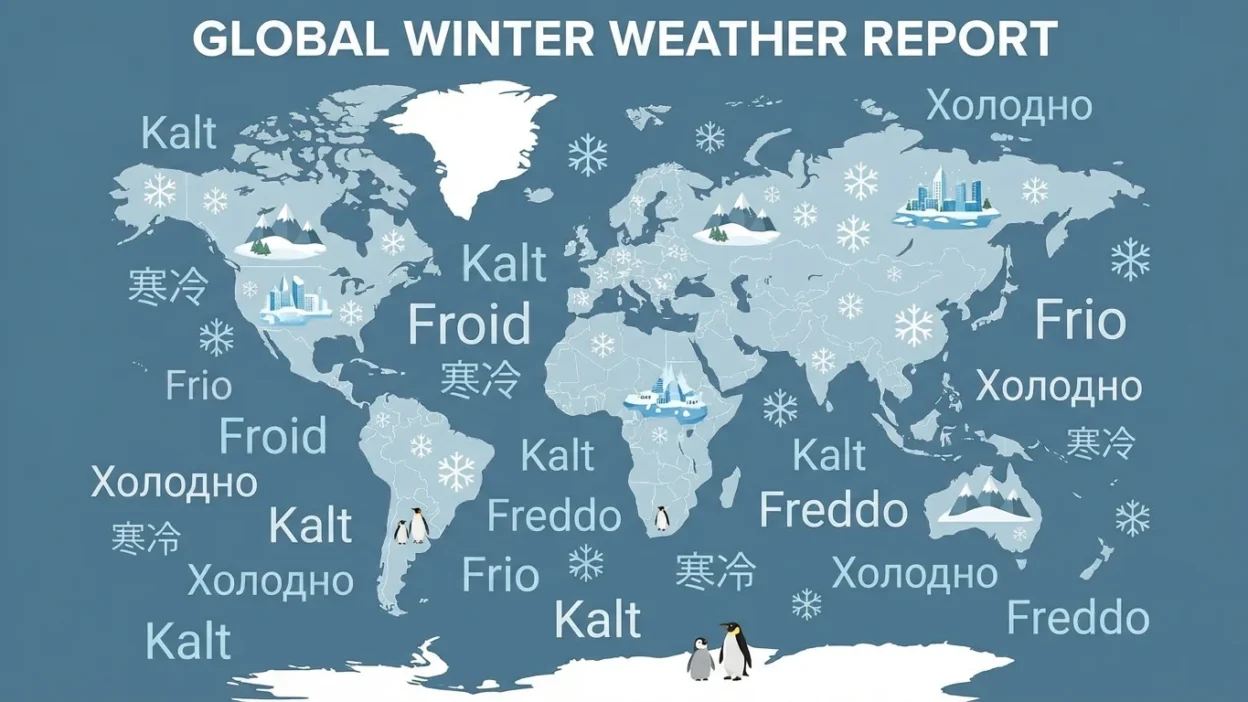
The word cold is commonly used to describe low temperature, chilly weather, or something that feels cool to the touch. People use it in everyday conversations when talking about the weather, food, drinks, or how they feel physically. Although the meaning is universal, each language has its own unique way of expressing the word.
Learning cold in different languages can be helpful for travelers, language learners, and anyone exploring global cultures. It helps people describe weather conditions, talk about temperature, and understand basic vocabulary in many languages. In this guide, you will discover 70 cold translations around the world, along with pronunciation and example sentences showing how the word is used naturally.
Cold in 70 Different Languages Around the World
| Language | Phrase & Pronunciation | Example Sentence |
|---|---|---|
| English | Cold (kohld) | The weather is very cold today. |
| Spanish | Frío (FREE-oh) | Hoy hace mucho frío. |
| French | Froid (frwah) | Il fait froid aujourd’hui. |
| German | Kalt (kalt) | Heute ist es sehr kalt. |
| Italian | Freddo (FRED-do) | Oggi fa freddo. |
| Portuguese | Frio (FREE-oh) | Hoje está muito frio. |
| Dutch | Koud (kowd) | Het is vandaag koud. |
| Russian | Холодно (kho-LOD-na) | Сегодня очень холодно. |
| Ukrainian | Холодно (kho-LOD-no) | Сьогодні дуже холодно. |
| Polish | Zimno (ZEEM-no) | Dzisiaj jest zimno. |
| Czech | Chladno (HLAD-no) | Dnes je chladno. |
| Slovak | Chladno (HLAD-no) | Dnes je chladno. |
| Hungarian | Hideg (HEE-deg) | Ma hideg van. |
| Romanian | Rece (RE-che) | Afară este rece. |
| Greek | Κρύο (KREE-o) | Κάνει πολύ κρύο σήμερα. |
| Turkish | Soğuk (so-UK) | Hava çok soğuk. |
| Arabic | بارد (ba-rid) | الطقس بارد اليوم. |
| Hebrew | קר (kar) | היום קר מאוד. |
| Persian | سرد (sard) | امروز هوا سرد است. |
| Hindi | ठंडा (THAN-da) | आज मौसम ठंडा है। |
| Urdu | سرد (sard) | آج موسم سرد ہے۔ |
| Bengali | ঠান্ডা (thon-da) | আজ আবহাওয়া ঠান্ডা। |
| Punjabi | ਠੰਢਾ (thon-da) | ਅੱਜ ਮੌਸਮ ਠੰਢਾ ਹੈ। |
| Gujarati | ઠંડુ (thon-du) | આજે હવામાન ઠંડુ છે. |
| Marathi | थंड (thand) | आज हवामान थंड आहे. |
| Tamil | குளிர் (ku-lir) | இன்று மிகவும் குளிர். |
| Telugu | చల్లగా (chal-la-ga) | ఈరోజు చల్లగా ఉంది. |
| Kannada | ಚಳಿ (cha-li) | ಇಂದು ತುಂಬ ಚಳಿ ಇದೆ. |
| Malayalam | തണുപ്പ് (tha-nup) | ഇന്ന് തണുപ്പ് ആണ്. |
| Sinhala | සීතල (see-tha-la) | අද කාලගුණය සීතලයි. |
| Thai | หนาว (nao) | วันนี้อากาศหนาว. |
| Vietnamese | Lạnh (lanh) | Hôm nay trời lạnh. |
| Indonesian | Dingin (ding-in) | Hari ini sangat dingin. |
| Malay | Sejuk / Dingin (se-jook) | Hari ini sangat sejuk. |
| Filipino | Malamig (ma-la-mig) | Malamig ang panahon ngayon. |
| Chinese (Mandarin) | 冷 (leng) | 今天很冷. |
| Japanese | 寒い (sa-mu-i) | 今日は寒いです。 |
| Korean | 춥다 (chup-da) | 오늘 날씨가 춥다. |
| Mongolian | Хүйтэн (khui-ten) | Өнөөдөр хүйтэн байна. |
| Swahili | Baridi (ba-ree-di) | Leo kuna baridi. |
| Zulu | Kuyabanda (ku-ya-ban-da) | Namuhla kuyabanda. |
| Afrikaans | Koud (kowd) | Vandag is dit koud. |
| Somali | Qabow (qa-bow) | Maanta waa qabow. |
| Amharic | ቀዝቃዛ (kez-ka-za) | ዛሬ ቀዝቃዛ ነው. |
| Hausa | Sanyi (san-yi) | Yau sanyi ne. |
| Yoruba | Tutu (too-too) | O tutu loni. |
| Igbo | Oyi (o-yi) | Oyi dị taa. |
| Danish | Kold (kold) | Det er koldt i dag. |
| Swedish | Kall (kal) | Det är kallt idag. |
| Norwegian | Kald (kald) | Det er kaldt i dag. |
| Finnish | Kylmä (kyl-ma) | Tänään on kylmä. |
| Icelandic | Kalt (kalt) | Það er kalt í dag. |
| Estonian | Külm (kylm) | Täna on külm. |
| Latvian | Auksts (auksts) | Šodien ir auksts. |
| Lithuanian | Šalta (shal-ta) | Šiandien šalta. |
| Serbian | Хладно (hla-dno) | Данас је хладно. |
| Croatian | Hladno (hla-dno) | Danas je hladno. |
| Bosnian | Hladno (hla-dno) | Danas je hladno. |
| Slovenian | Mrzlo (mrz-lo) | Danes je mrzlo. |
| Albanian | Ftohtë (ftoh-te) | Sot është ftohtë. |
| Macedonian | Ладно (lad-no) | Денес е ладно. |
| Georgian | ცივი (tsi-vi) | დღეს ცივა. |
| Armenian | Սառը (sar-re) | Այսօր շատ սառը է. |
| Kazakh | Суық (su-ik) | Бүгін суық. |
| Uzbek | Sovuq (so-vuq) | Bugun sovuq. |
| Tajik | Сард (sard) | Имрӯз ҳаво сард аст. |
| Nepali | चिसो (chi-so) | आज मौसम चिसो छ। |
| Khmer | ត្រជាក់ (tro-cheak) | ថ្ងៃនេះត្រជាក់. |
| Lao | ໜາວ (nao) | ມື້ນີ້ໜາວ. |
The Meaning of “Cold” in Different Languages
The word cold usually refers to low temperature. It can describe weather conditions, cold objects, or even feelings in some contexts. Many languages have different forms depending on grammar, but the meaning remains similar.
When exploring cold in all languages, you may notice that some languages use the same word for both cold weather and cold objects, while others use separate terms.
How the Word Cold Is Used in Everyday Conversation
People commonly use the word cold when talking about:
Weather and seasons
Cold drinks or food
Physical sensations
Temperature descriptions
Understanding cold translations around the world helps people communicate about weather and climate in different countries.
Why Learning Temperature Words in Different Languages Is Useful
Temperature vocabulary is practical for travelers and language learners. Knowing how to say cold in different languages helps when discussing weather, packing for trips, or talking with locals about climate.
These simple words make everyday communication easier in any language.
Conclusion
The word cold is used everywhere to describe low temperatures and chilly conditions. Although each language expresses it differently, the meaning remains universal.
By learning cold in different languages, you expand your vocabulary and improve your ability to communicate about weather and temperature around the world.
FAQs
What is the word cold in different languages?
Examples include Frío (Spanish), Froid (French), Kalt (German), Soğuk (Turkish), and 冷 (Chinese).
How do you say cold in 10 common languages?
English (Cold), Spanish (Frío), French (Froid), German (Kalt), Italian (Freddo), Arabic (Barid), Hindi (Thanda), Chinese (Leng), Japanese (Samui), and Turkish (Soğuk).
Why do languages have different words for cold?
Languages develop unique vocabulary based on grammar, climate, and cultural influences.
Is weather vocabulary important in language learning?
Yes, weather words like cold, hot, rain, and wind are used frequently in daily conversations.
Can the word cold have other meanings?
Yes, it can also describe emotions, illnesses, or objects with low temperature.