
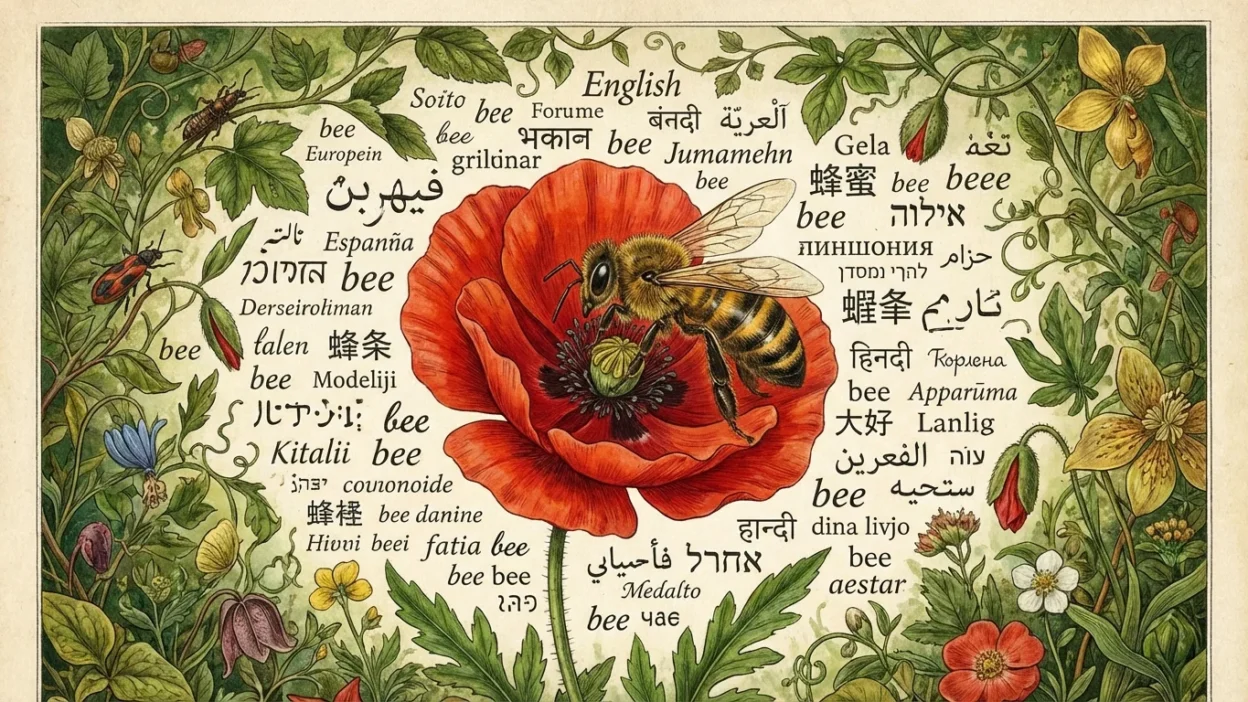
The word bee refers to a small flying insect known for producing honey and pollinating plants. Bees play a crucial role in nature and agriculture, making them important across cultures worldwide. While the insect is the same everywhere, the word for it changes from language to language.
Learning bee in different languages is useful for students, travelers, and nature lovers. It also helps expand vocabulary and understand how different cultures describe animals and insects. In this guide, you’ll discover 70 bee translations around the world, along with pronunciation and simple example sentences.
Bee in 70 Different Languages Around the World
| Language | Phrase & Pronunciation | Example Sentence |
|---|---|---|
| English | Bee (bee) | The bee is on the flower. |
| Spanish | Abeja (a-BE-ha) | La abeja está en la flor. |
| French | Abeille (a-BAY) | L’abeille est sur la fleur. |
| German | Biene (BEE-ne) | Die Biene ist auf der Blume. |
| Italian | Ape (A-pe) | L’ape è sul fiore. |
| Portuguese | Abelha (a-BEL-ya) | A abelha está na flor. |
| Dutch | Bij (bai) | De bij zit op de bloem. |
| Russian | Пчела (pchye-LA) | Пчела на цветке. |
| Ukrainian | Бджола (bdzho-LA) | Бджола на квітці. |
| Polish | Pszczoła (psh-CHO-wa) | Pszczoła jest na kwiatku. |
| Czech | Včela (vche-la) | Včela je na květině. |
| Slovak | Včela (vche-la) | Včela je na kvete. |
| Hungarian | Méh (mayh) | A méh a virágon van. |
| Romanian | Albină (al-BEE-na) | Albina este pe floare. |
| Greek | Μέλισσα (ME-lis-sa) | Η μέλισσα είναι στο λουλούδι. |
| Turkish | Arı (a-ru) | Arı çiçekte. |
| Arabic | نحلة (nah-la) | النحلة على الزهرة. |
| Hebrew | דבורה (dvo-RA) | הדבורה על הפרח. |
| Persian | زنبور (zan-boor) | زنبور روی گل است. |
| Hindi | मधुमक्खी (ma-dhu-mak-khi) | मधुमक्खी फूल पर है। |
| Urdu | شہد کی مکھی (shehad ki mak-khi) | شہد کی مکھی پھول پر ہے۔ |
| Bengali | মৌমাছি (mou-ma-chi) | মৌমাছি ফুলে আছে। |
| Punjabi | ਮੱਖੀ (mak-khi) | ਮੱਖੀ ਫੁੱਲ ਤੇ ਹੈ। |
| Gujarati | મધમાખી (madh-ma-khi) | મધમાખી ફૂલ પર છે. |
| Marathi | मधमाशी (madh-ma-shi) | मधमाशी फुलावर आहे. |
| Tamil | தேனீ (the-nee) | தேனீ பூவில் உள்ளது. |
| Telugu | తేనెటీగ (the-ne-tee-ga) | తేనెటీగ పువ్వుపై ఉంది. |
| Kannada | ಜೇನುಹುಳು (je-nu-hu-lu) | ಜೇನುಹುಳು ಹೂವಿನ ಮೇಲೆ ಇದೆ. |
| Malayalam | തേൻച്ചൂട് (then-chood) | തേൻച്ചൂട് പൂവിൽ ആണ്. |
| Sinhala | මී මැසි (mee ma-si) | මී මැසි මලේ ඇත. |
| Thai | ผึ้ง (pheung) | ผึ้งอยู่บนดอกไม้. |
| Vietnamese | Ong (ong) | Ong ở trên hoa. |
| Indonesian | Lebah (le-bah) | Lebah ada di bunga. |
| Malay | Lebah (le-bah) | Lebah di atas bunga. |
| Filipino | Bubuyog (bu-bu-yog) | Ang bubuyog ay nasa bulaklak. |
| Chinese (Mandarin) | 蜜蜂 (mi feng) | 蜜蜂在花上. |
| Japanese | 蜂 (ha-chi) | 蜂は花にいます。 |
| Korean | 벌 (beol) | 벌은 꽃에 있다. |
| Mongolian | Зөгий (zog-ee) | Зөгий цэцгэн дээр байна. |
| Swahili | Nyuki (nyu-ki) | Nyuki yuko kwenye ua. |
| Zulu | Inyosi (in-yo-si) | Inyosi isembali. |
| Afrikaans | By (bai) | Die by is op die blom. |
| Somali | Shinbir malab (shin-bir ma-lab) | Shinbir malab waa ubax. |
| Amharic | ንብ (nib) | ንብ በአበባ ላይ ነው. |
| Hausa | Zuma (zu-ma) | Zuma tana kan fure. |
| Yoruba | Oyin (o-yin) | Oyín wà lórí ododo. |
| Igbo | Anụ ọkụ (a-nu ok-wo) | Anụ ọkụ nọ n’elu ifuru. |
| Danish | Bi (bee) | Bien er på blomsten. |
| Swedish | Bi (bee) | Biet är på blomman. |
| Norwegian | Bie (bee) | Bien er på blomsten. |
| Finnish | Mehiläinen (me-hi-lai-nen) | Mehiläinen on kukalla. |
| Icelandic | Býfluga (bee-flu-ga) | Býflugan er á blóminu. |
| Estonian | Mesilane (me-si-la-ne) | Mesilane on lillel. |
| Latvian | Bite (bi-te) | Bite ir uz zieda. |
| Lithuanian | Bitė (bi-te) | Bitė yra ant gėlės. |
| Serbian | Пчела (pche-la) | Пчела је на цвету. |
| Croatian | Pčela (pche-la) | Pčela je na cvijetu. |
| Bosnian | Pčela (pche-la) | Pčela je na cvijetu. |
| Slovenian | Čebela (che-be-la) | Čebela je na cvetu. |
| Albanian | Bletë (ble-te) | Bleta është në lule. |
| Macedonian | Пчела (pche-la) | Пчелата е на цветот. |
| Georgian | ფუტკარი (fut-ka-ri) | ფუტკარი ყვავილზეა. |
| Armenian | Մեղու (me-ghu) | Մեղուն ծաղկի վրա է. |
| Kazakh | Ара (a-ra) | Ара гүлде отыр. |
| Uzbek | Asalari (a-sa-la-ri) | Asalari gulda. |
| Tajik | Занбӯр (zan-boor) | Занбӯр дар гул аст. |
| Nepali | मौरी (mau-ri) | मौरी फूलमा छ। |
| Khmer | ឃ្មុំ (khmum) | ឃ្មុំលើផ្កា. |
| Lao | ເຜິ້ງ (pheung) | ເຜິ້ງຢູ່ດອກໄມ້. |
The Meaning of “Bee” in Different Languages
A bee is a flying insect known for making honey and helping pollinate flowers. It plays a vital role in ecosystems and agriculture worldwide.
When exploring bee in all languages, you’ll notice that many words are unique and reflect local linguistic styles.
How the Word Bee Is Used in Everyday Conversations
People use the word bee when talking about:
Nature and insects
Farming and pollination
Honey production
Education and science
Understanding bee translations around the world helps in learning about nature and biology.
Why Learning Animal and Insect Names in Different Languages Is Useful
Learning how to say bee in different languages improves vocabulary and helps in understanding nature-related topics across cultures.
It is especially helpful for students and travelers.
Conclusion
The word bee may be small, but its importance is huge across the world. While each language expresses it differently, the meaning remains universal.
By learning bee in different languages, you expand your vocabulary and connect with global knowledge about nature.
FAQs
What is bee in different languages?
Examples include Abeja (Spanish), Abeille (French), Biene (German), Arı (Turkish), and 蜜蜂 (Chinese).
How do you say bee in 10 common languages?
English (Bee), Spanish (Abeja), French (Abeille), German (Biene), Italian (Ape), Arabic (Nahla), Hindi (Madhumakkhi), Chinese (Mi Feng), Japanese (Hachi), and Turkish (Arı).
Why are bees important worldwide?
Bees help pollinate plants and produce honey, making them essential for ecosystems.
Is bee a common word in language learning?
Yes, it is part of basic animal and nature vocabulary.
Do all languages have a word for bee?
Yes, because bees exist globally and are important in nature.