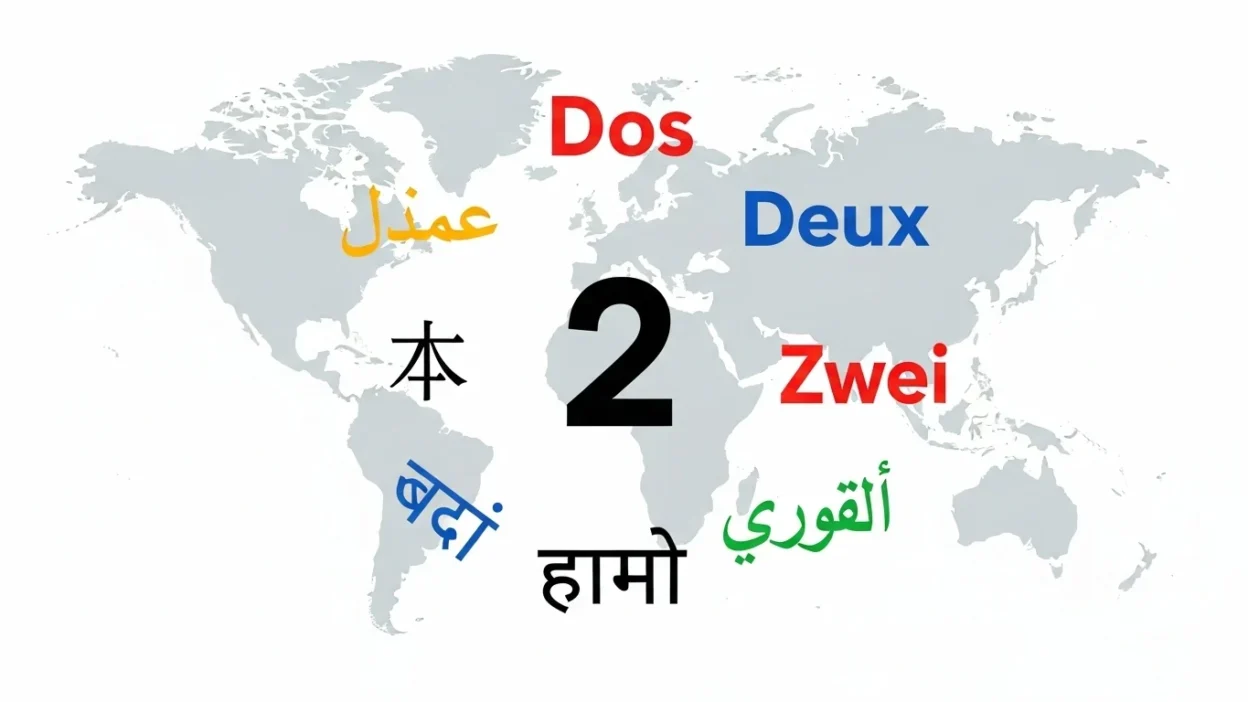
Numbers are the foundation of every language, and learning how to say 2 in different languages is a simple yet powerful step toward mastering global communication. If you’re traveling, studying, or just curious, knowing how to count across cultures helps you connect with people worldwide.
If you’re searching for 2 in all languages, 2 translations, or how to say 2 in different languages, this complete guide provides everything you need in one place. Below is a carefully organized table with 70 languages, including pronunciation and real-life examples.
2 in Different Languages (70 Translations Table)
| Language | Phrase / Example Sentence | Meaning |
|---|---|---|
| English | Two (too) – I have two apples. | I have 2 apples |
| Spanish | Dos (dohs) – Tengo dos libros. | I have 2 books |
| French | Deux (duh) – J’ai deux chats. | I have 2 cats |
| German | Zwei (tsvai) – Ich habe zwei Hunde. | I have 2 dogs |
| Italian | Due (doo-eh) – Ho due amici. | I have 2 friends |
| Portuguese | Dois (doysh) – Tenho dois carros. | I have 2 cars |
| Dutch | Twee (tvay) – Ik heb twee fietsen. | I have 2 bikes |
| Russian | Два (dva) – У меня два брата. | I have 2 brothers |
| Arabic | اثنان (ith-nan) – لدي اثنان من الكتب. | I have 2 books |
| Turkish | İki (ee-kee) – İki kalemim var. | I have 2 pens |
| Hindi | दो (do) – मेरे पास दो सेब हैं। | I have 2 apples |
| Urdu | دو (do) – میرے پاس دو کتابیں ہیں۔ | I have 2 books |
| Bengali | দুই (dui) – আমার দুই বন্ধু আছে। | I have 2 friends |
| Punjabi | ਦੋ (do) – ਮੇਰੇ ਕੋਲ ਦੋ ਗੱਡੀਆਂ ਹਨ। | I have 2 cars |
| Chinese | 二 (èr) – 我有两个苹果。 | I have 2 apples |
| Japanese | 二 (ni) – 私は二つ持っています。 | I have 2 things |
| Korean | 둘 (dul) – 나는 둘 있어요. | I have 2 |
| Thai | สอง (song) – ฉันมีสองเล่ม | I have 2 books |
| Vietnamese | Hai (hai) – Tôi có hai con mèo. | I have 2 cats |
| Indonesian | Dua (doo-a) – Saya punya dua buku. | I have 2 books |
| Malay | Dua (doo-a) – Saya ada dua kereta. | I have 2 cars |
| Filipino | Dalawa (da-la-wa) – May dalawa ako. | I have 2 |
| Greek | Δύο (thee-o) – Έχω δύο φίλους. | I have 2 friends |
| Polish | Dwa (dva) – Mam dwa psy. | I have 2 dogs |
| Czech | Dva (dva) – Mám dva domy. | I have 2 houses |
| Slovak | Dva (dva) – Mám dva bratov. | I have 2 brothers |
| Hungarian | Kettő (ket-toe) – Van kettő almám. | I have 2 apples |
| Romanian | Doi (doy) – Am doi frați. | I have 2 brothers |
| Bulgarian | Две (dve) – Имам две книги. | I have 2 books |
| Serbian | Dva (dva) – Imam dva psa. | I have 2 dogs |
| Croatian | Dva (dva) – Imam dva auta. | I have 2 cars |
| Slovenian | Dva (dva) – Imam dva prijatelja. | I have 2 friends |
| Ukrainian | Два (dva) – У мене два коти. | I have 2 cats |
| Persian | دو (do) – من دو کتاب دارم. | I have 2 books |
| Hebrew | שתיים (shtayim) – יש לי שתיים. | I have 2 |
| Swahili | Mbili (m-bi-li) – Nina mbili. | I have 2 |
| Zulu | Kubili (ku-bi-li) – Ngine kubili. | I have 2 |
| Afrikaans | Twee (tvee) – Ek het twee honde. | I have 2 dogs |
| Somali | Laba (la-ba) – Waxaan hayaa laba. | I have 2 |
| Amharic | ሁለት (hu-let) – ሁለት አለኝ | I have 2 |
| Yoruba | Meji (meh-jee) – Mo ni meji. | I have 2 |
| Igbo | Abụọ (a-boo-o) – Enwere m abụọ. | I have 2 |
| Hausa | Biyu (bee-yu) – Ina da biyu. | I have 2 |
| Finnish | Kaksi (kak-see) – Minulla on kaksi. | I have 2 |
| Swedish | Två (tvoh) – Jag har två böcker. | I have 2 books |
| Norwegian | To (too) – Jeg har to venner. | I have 2 friends |
| Danish | To (too) – Jeg har to biler. | I have 2 cars |
| Icelandic | Tveir (tvayr) – Ég á tveir hundar. | I have 2 dogs |
| Estonian | Kaks (kaks) – Mul on kaks. | I have 2 |
| Latvian | Divi (di-vi) – Man ir divi. | I have 2 |
| Lithuanian | Du (doo) – Aš turiu du. | I have 2 |
| Albanian | Dy (doo) – Kam dy libra. | I have 2 books |
| Macedonian | Два (dva) – Имам два пријатели. | I have 2 friends |
| Georgian | ორი (ori) – მე მაქვს ორი. | I have 2 |
| Armenian | Երկու (yer-ku) – Ես ունեմ երկու։ | I have 2 |
| Nepali | दुई (dui) – मसँग दुई छन्। | I have 2 |
| Sinhala | දෙක (deka) – මට දෙකක් තියෙනවා | I have 2 |
| Tamil | இரண்டு (irandu) – எனக்கு இரண்டு உள்ளது | I have 2 |
| Telugu | రెండు (rendu) – నాకు రెండు ఉన్నాయి | I have 2 |
| Kannada | ಎರಡು (eradu) – ನನಗೆ ಎರಡು ಇದೆ | I have 2 |
| Malayalam | രണ്ട് (randu) – എനിക്ക് രണ്ട് ഉണ്ട് | I have 2 |
| Marathi | दोन (don) – माझ्याकडे दोन आहेत | I have 2 |
| Gujarati | બે (be) – મારા પાસે બે છે | I have 2 |
| Khmer | ពីរ (pii) – ខ្ញុំមានពីរ | I have 2 |
| Lao | ສອງ (song) – ຂ້ອຍມີສອງ | I have 2 |
| Mongolian | Хоёр (hoyor) – Надад хоёр бий | I have 2 |
| Burmese | နှစ် (hnit) – ကျွန်တော်မှာ နှစ်ခုရှိသည် | I have 2 |
| Malagasy | Roa (roo-a) – Manana roa aho | I have 2 |
Why Learn “2” in Different Languages?
Understanding 2 around the world helps in everyday situations like shopping, counting, and basic conversations. Numbers are universal, and mastering them makes learning new languages easier.
Common Patterns in Number Translations
- Many European languages share similar roots like dos, deux, due
- Asian languages often use shorter, unique sounds
- African languages may use rhythmic or descriptive forms
Recognizing these patterns helps speed up learning.
Tips to Remember 2 in Different Languages
- Practice counting daily in multiple languages
- Use real-life objects (like “2 books”)
- Repeat pronunciation out loud
- Group similar-sounding languages
Conclusion
Learning how to say 2 in different languages is a simple yet powerful step toward multilingual communication. With these 70 translations, you can now confidently recognize and use this essential number anywhere in the world.
FAQs
1. How do you say 2 in most languages?
Many languages use similar-sounding words like “do,” “dos,” or “du.”
2. What is 2 in Asian languages?
In Chinese it’s “èr,” in Japanese “ni,” and in Hindi “do.”
3. Is 2 easy to learn in different languages?
Yes, numbers are among the easiest vocabulary to learn.
4. Why are number words similar in some languages?
Because many languages share historical roots.
5. What is the fastest way to learn numbers globally?
Practice daily and group languages by similarity.